

Every founder we talk to eventually asks some version of the same question: "Should I just hire a freelancer, bring on a technical co-founder, or work with an agency?" There's no universally right answer, but there is a wrong way to make the decision — picking based on sticker price alone. The upfront cost is the least important number in this equation.
What You're Actually Buying
An MVP isn't just code. It's a working product that has to survive contact with real users, get iterated on based on what you learn, and — if things go well — scale without a rebuild. The question isn't "who's cheapest to write the first version." It's "who gets me to a validated product fastest, without creating a mess I have to pay to unwind six months from now."
With that framing, here's how the three options actually compare.
Freelancers: Fast and Cheap, Until They're Not
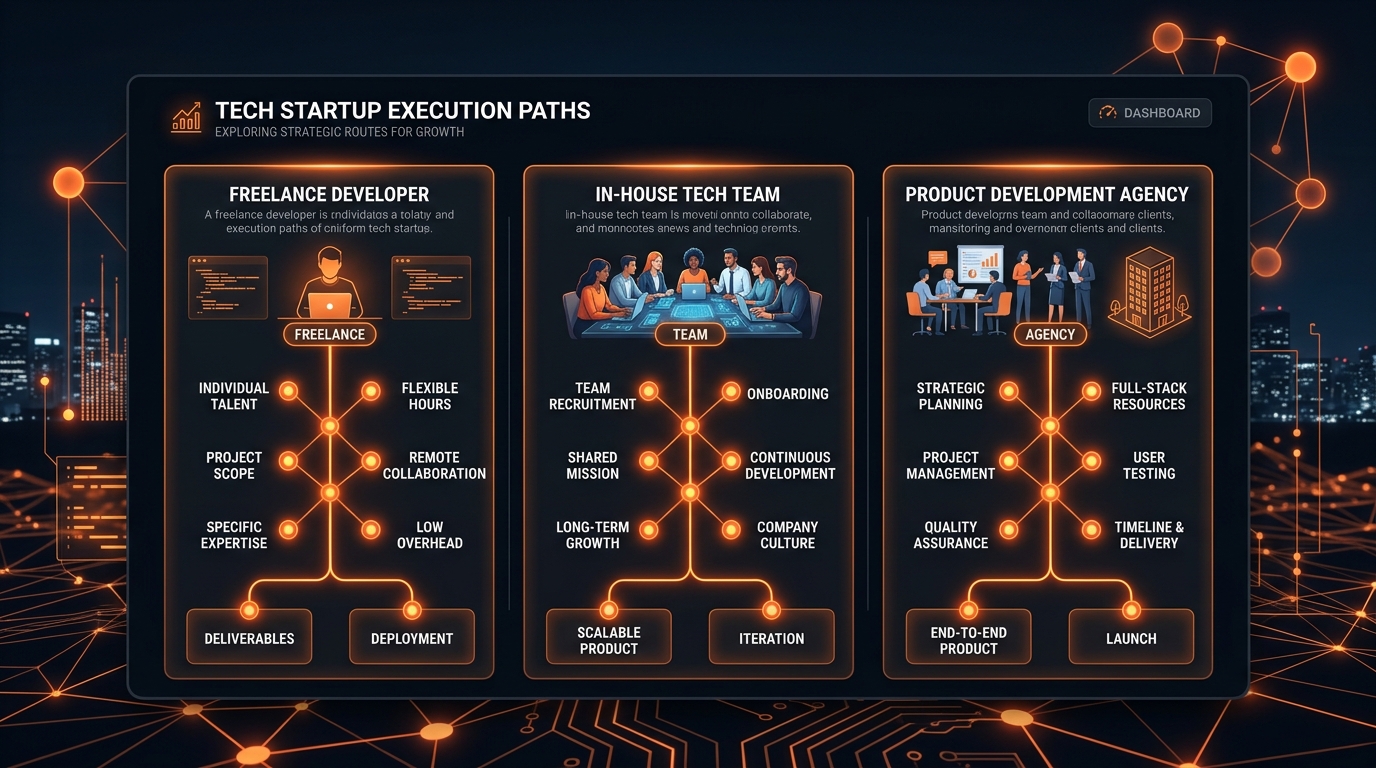
A good freelancer is genuinely great for a narrow, well-defined task — a landing page, a specific integration, a design pass. The trouble starts when you hand a freelancer an entire MVP with a fuzzy spec, because the gaps in that spec get filled with whatever assumptions are fastest for them to build, not what's right for your product.
The other risk is availability. Freelancers juggle multiple clients. If yours is mid-build and picks up another project, your timeline slips and you have limited leverage to do anything about it. And if they disappear entirely — which happens more than anyone likes to admit — you're often left with code only they fully understand.
Freelancers make the most sense when you already have technical judgment in-house to direct and review the work, and the scope is genuinely small.
In-House Hire: Long-Term Right, Short-Term Slow
Hiring a full-time engineer (or co-founder) is the right long-term move for almost every serious SaaS company eventually. The problem is timing. Recruiting, interviewing, and onboarding a good engineer typically takes 6-12 weeks minimum before they're productive — and that's assuming you, as a non-technical or partially-technical founder, can accurately evaluate who's actually good.
There's also a validation risk hiding in this option: you're making an expensive, months-long commitment (salary, equity, management time) before you know if the product is something the market wants. A lot of founders end up building the wrong MVP slowly and expensively, when what they needed first was a fast, cheap way to find out if they were even solving the right problem. See our guide on building production-ready SaaS MVPs in 14 days.
In-house hiring makes the most sense once you have product-market fit signal and need someone to own the codebase long-term — not as the very first step.
Agencies: The Middle Path, If You Pick the Right One
A development agency sits between the two — faster to start than hiring, more structured and accountable than a solo freelancer. You get a team with existing processes: someone doing architecture, someone doing frontend, someone thinking about deployment and scaling, without you having to assemble and manage that team yourself.
The tradeoff is cost per hour is usually higher than a single freelancer, and agency quality varies enormously — this is genuinely the riskiest part of the decision, because a bad agency can be worse than either other option. The good ones treat your MVP like a real product with real users in mind, ask hard questions about scope before writing code, and hand you something you can actually maintain and extend afterward — not a fragile prototype held together with shortcuts.
Questions Worth Asking Before You Commit, Regardless of Route
- Who owns the code and the infrastructure after launch — you, or them?
- What happens if you need to change scope halfway through? Is that a conversation or a contract renegotiation?
- Can you see (and ideally talk to) a past client whose product is still live and being iterated on, not just a portfolio screenshot?
- What's the actual plan for what happens after the MVP ships — who fixes bugs, who owns hosting, who's around in three months?
That last question eliminates more bad options than any pricing comparison will.
The Honest Answer
For most first-time SaaS founders without a technical co-founder already in place, a good agency is usually the fastest, lowest-risk path to a real, working MVP you can put in front of users — provided you vet them properly using the questions above. Freelancers work well for narrow pieces once you have technical direction. In-house hiring is the right move once you know what you're scaling, not before.
If you're weighing this decision right now, we're happy to just talk it through — no pitch required, we'll tell you honestly if an agency is even the right fit for what you're building.